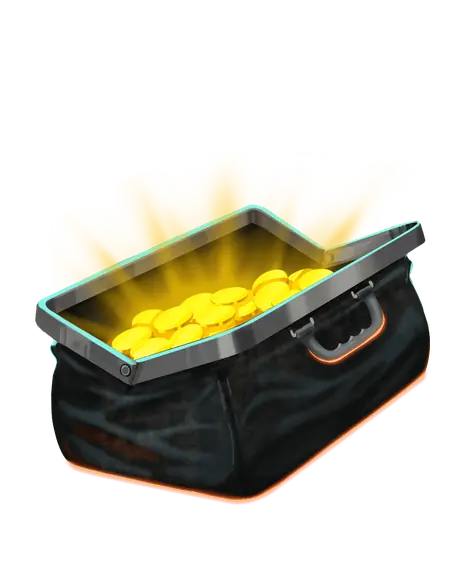
In and Out Heist Mode: the three-spin collection round
Heist Mode is where the rest of the game is cashed in. Everything the cascade marked, everything the bombs added, and the tier each position managed to reach all turn into a single board that is filled over a short, fixed number of spins.
It is a hold-and-collect round in the usual sense, with one difference worth naming up front: the board it uses was not handed out at random. It was built by what happened earlier in the same round.
3Starting spins
x0.5, x1, x1.5 or x2Bronze coins
x4, x6, x8 or x10Silver coins
x15, x20, x25 or x30Gold coins
x50, x100, x200 or x1,000Diamond positions
x2, x3, x4, x5 or x10Multiplier valuesapplied at the end
What opens it, and why it is not a separate game
The round opens when two things are true at the same moment: Chloe is on the screen, and
at least one position is marked. Both are checked only once every cascade in the round has
finished, which is the right order — the cascades are what create the marks in the first
place, so testing earlier would be testing an unfinished board.
That dependency is the reason this round feels different from a bolted-on bonus. It is not
awarded by three scatters landing in the right place; it is awarded by the round having
developed in a particular way. A spin that paid nothing cannot open it, because nothing was
marked. A spin that paid four times across the middle of the board, with Chloe still
standing, very likely can.
Inside the round: a board that fills while the counter runs down
The marked area becomes the playing field and the rest of the screen stops mattering. Every
position inside the area that is still empty spins on its own, independently of its
neighbours. Only a short list of things can land there: coins, diamonds, bonus symbols and
the round's own specials. Anything of value that lands stays where it is for the remainder of
the round rather than being cleared.
The counter starts at 3. It falls by one with each spin of the area and is
pushed back up by one every time an Extra Life lands, which is then taken off the board on
the following spin. The round ends the moment the counter reaches zero or the area is
completely full — whichever arrives first — and the accumulated total is settled then, not
as it goes along.
A Collector sweeps up the value of every coin, diamond and earlier Collector on the board,
then stays behind holding it.
Coin values, and why the tier underneath them is the whole point
A coin is worth what its position allows. On a bronze position the values available are
x0.5, x1, x1.5 or x2; silver carries x4, x6, x8 or x10; gold carries x15, x20, x25 or x30; and a diamond position
holds a diamond rather than a coin, with x50, x100, x200 or x1,000 on offer. The gap between the bottom
of the bronze range and the top of the diamond one is the single widest spread in the game.
This is the answer to why the cascade matters so much. A position that climbed to gold during
the base round is not merely a nicer-looking tile; it is a tile that can hold thirty times the
stake instead of two. Every upgrade earlier in the round is a change to what this round is
even able to award, and that is a more direct link between base play and bonus play than most
games of this kind bother with.
Both ends of that spread are published values, not observed ones. How often a diamond position
exists at all, and how often one is filled, is not something this site has recorded or is in a
position to estimate.
Upgrader, Burst, Blast, Extra Life, Collector
Five specials can land inside the area, and between them they are what makes two collection
rounds on identical boards end differently.
Upgrader
Lifts every position immediately next to it by one tier — bronze to silver, silver to gold,
gold to diamond — and will also promote a bonus symbol to a Super Bonus. Positions it reaches
that were not part of the area are pulled into it at bronze.
Burst
Converts a random set of unmarked positions to its own tier, bringing them into the area. It
can reach outside the current play area, which means the board this round is being played on
can grow after the round has already started.
Blast
What happens when an Upgrader and a Burst land together. The two effects combine and resolve
at the higher of the two tiers, and coin values are added directly to the empty positions the
pair has affected.
Extra Life and Collector
An Extra Life is one more spin, and nothing else — it disappears afterwards. A Collector
gathers the value of every coin, diamond and earlier Collector currently on the board,
removes what it has taken, and remains in place holding the total. When a second Collector
appears it takes everything the first was holding, and both leave.
How to watch this round without reading it as a puzzle
The round is a sequence of independent position spins against a counter. There is nothing in
it a player chooses, nothing to time and nothing to hold back. The specials land or they do
not; the area grows or it does not; the counter runs out or the board fills. Describing it as
a set of rules rather than a problem with a solution is not modesty, it is accuracy — there
is no input between the spin that opened it and the total that is settled at the end.
The multiplier is the one part that invites a different reading, because it arrives early and
pays late: a multiplier symbol of x2, x3, x4, x5 or x10 applies to the coins, diamonds and
Collectors at the end of the round rather than when it lands. That delay makes it look as
though the round is building towards a climax that can be managed. It cannot. It is simply an
order of operations.
The four questions this round raises most often
Each answer is repeated word for word in this page's structured data.
What opens the collection round?
Chloe on the screen alongside at least one marked position, once every cascade in the round has finished.
How many spins does it start with?
3. An Extra Life symbol hands one back, and it is removed from the board on the spin after it lands.
What decides how much a coin is worth?
The tier of the position it lands on. Bronze holds x0.5, x1, x1.5 or x2; diamond positions hold x50, x100, x200 or x1,000.
How does the round end?
Either the spin counter reaches zero or the area fills completely. The total is then settled and play returns to the spin that opened it.